There are certain old things that make us stop and wonder. Not necessarily because of their beauty alone, but because of the lives they may have touched and the stories they carry with them.
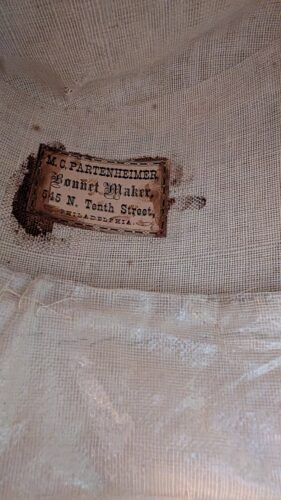
Such is the case with a remarkable mid-19th-century bonnet, dating approximately 1858–1865, bearing the maker’s label of M.C. Partenheimer, Bonnet Maker, 545 N. Tenth Street, Philadelphia.
Nearly 170 years have passed since this bonnet was made. Think for a moment of the woman who might have worn it. What was her daily life like? Where did she go? Was this bonnet reserved for special occasions, or was it part of her everyday wardrobe?
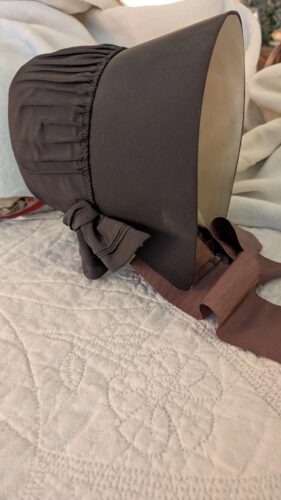
We can look closely at its workmanship, construction, and maker’s mark, but the woman who once wore it remains a mystery.
And then there is the question that makes this particular bonnet even more intriguing.
How did a bonnet made by a Philadelphia bonnet maker find its way to a small rural community in Ohio?
A Philadelphia Maker’s Mark
One of the most exciting discoveries is the maker’s label preserved inside the bonnet.
It reads:
**M.C. Partenheimer**\
**Bonnet Maker**\
**545 N. Tenth Street**\
**Philadelphia**
What a wonderful little piece of history to have survived!
Rather than relying solely on the bonnet’s appearance to suggest its origins, we have the name of the maker and a specific Philadelphia address.
Our earlier research into Philadelphia’s historical street-numbering changes provided an important clue in establishing the approximate date. The address as it appears on the label points us toward the later 1850s and the years that followed.
This gives us a working date of approximately 1858–1865, placing the bonnet within the years surrounding the American Civil War.
A small label, easily overlooked, has helped us establish a much more meaningful historical connection.
Behind this bonnet was a maker whose name has survived when so many other details of its history have disappeared.
The Workmanship Behind the Bonnet
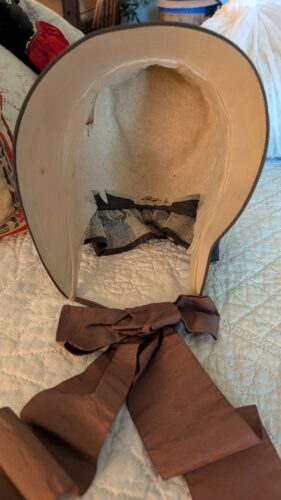
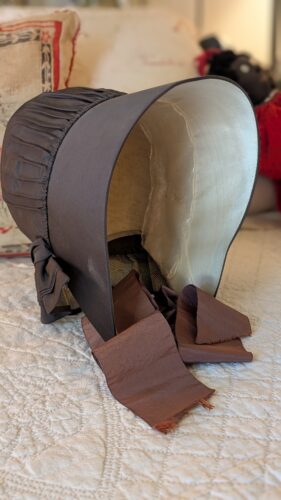
The inside of this bonnet offers another glimpse into the workmanship of mid-19th-century women’s dress.
The crown is fitted with a light-colored woven lining, while the interior of the brim is neatly finished and outlined with a darker binding. Across the back is an additional gathered openwork treatment, providing an interesting detail to the interior construction.
The original wide brown fabric ties remain attached and complete. One side is fashioned into a formed bow, with a small hook-and-eye fastening to secure the opposite tie.
Even these practical finishing details have survived intact, with no damage noted.
It is these features that allow us to appreciate the bonnet beyond its outward appearance. The construction, finishing, and original fastening remind us of the careful work involved in creating a woman’s headwear during this period.
For those interested in historical costume and textile preservation, such details are an important part of understanding an old garment.
An Inheritance, a Collection, or Perhaps Both?
When this group of older belongings came to light, there was more than just one or two interesting pieces. There was quite a collection of things from an earlier time.
My sister has wondered whether the former owner may have inherited some of these belongings, while also having an interest in collecting antiques. It is an interesting possibility, although we have no way of knowing for certain.
Perhaps family possessions were passed down through generations. Perhaps someone developed an appreciation for earlier clothing, textiles, and household objects and began acquiring them. Or perhaps an inheritance introduced someone to a world of old things that eventually became a passion.
It may even have been a little of both.
We should not overlook the possibility that this bonnet traveled through several hands before reaching its eventual home in Ohio. Its journey may have been much longer and more complicated than we can imagine.
The Importance of What Survives
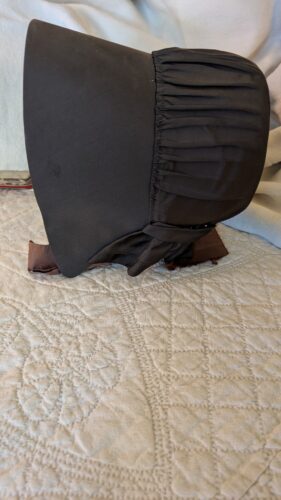
Women’s clothing from the mid-19th century offers us a wonderful glimpse into another time. Bonnets were an important part of a woman’s wardrobe, serving both practical and fashionable purposes.
Yet surviving examples are more than accessories from an old wardrobe. They are physical reminders of the women who made, wore, cared for, and preserved them.
The materials, construction, shape, and decorative details all help tell us something about the period in which they were created.
And sometimes, the simple fact that an object has survived is remarkable in itself. It may have been carefully stored away, passed along as an heirloom, or recognized by a later owner as something worth keeping.
Whatever the circumstances, this bonnet has survived nearly 170 years of changing fashions, households, and generations.
A Story Still Waiting to Be Told
We may never know the name of the woman who first wore this bonnet. We may never discover who carried it from Philadelphia to Ohio, or precisely when it arrived in its eventual home.
Was it a cherished family possession? A collector’s acquisition? Or a little of both?
Those questions remain unanswered, and perhaps that is part of its charm.
What we do have is a surviving example of mid-19th-century women’s hat, a named Philadelphia bonnet maker, and a tangible connection to a world nearly 170 years behind us.
I often think that the old things we encounter are not simply objects. They are reminders of ordinary lives, of careful hands, of things once treasured and saved.
Somewhere along its journey, someone decided this bonnet was worth keeping.
And now, perhaps, it is time for another chapter.
For the right collector, historical costume enthusiast, or museum, this bonnet offers an opportunity to preserve a little piece of women’s history for generations yet to come.
After all, every old treasure has a story. Sometimes we know the beginning, sometimes we can only imagine the middle, and sometimes the ending is still waiting to be written.
**This bonnet has given us a name, an address, a time period, and a journey from Philadelphia to rural Ohio. The rest is left to our imagination.**