There is something wonderfully touching about old schoolbooks. Perhaps it is because they were never meant to become treasures. They were meant to be **used**.
Opened every morning. Carried home at night. Set upon a wooden school desk. Thumbed through by small hands. And, when one child had finished with a book, quite possibly handed down to the next.
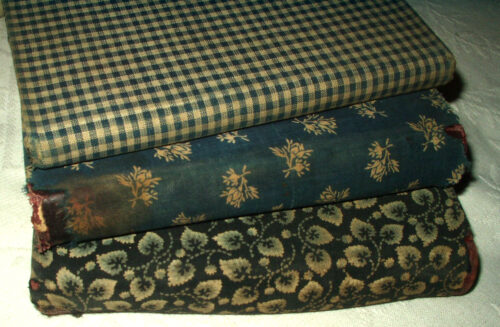
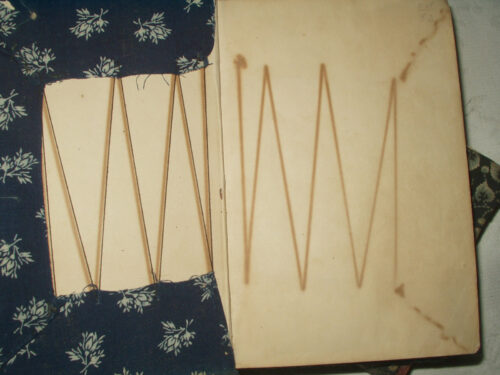
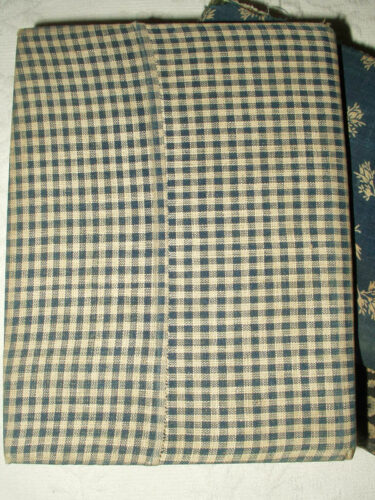
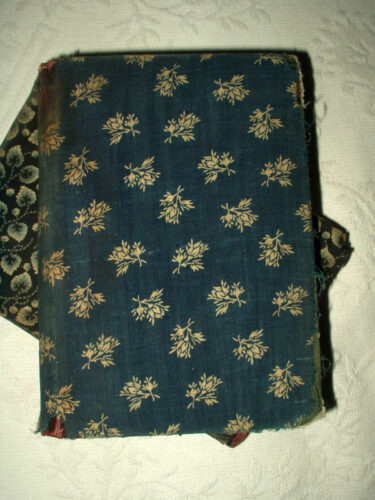
The three little books pictured here tell that story in a particularly charming way. These are not publisher’s cloth bindings. They were **covered at home**, carefully wrapped in scraps of cotton fabric to protect the books through the years of schoolroom use. And there is a wonderful bit of evidence left behind. Look closely at the books and you can see the impressions made by the thread that held the cloth covers in place. After years of being wrapped, handled and stored, the thread pressed against the book long enough to leave a darker line behind. The cloth may eventually be removed. The thread may disappear. .But the **evidence of the thread remains.**That is the sort of detail I love finding on an old object. It tells us not simply *what* something is, but **how it was used**.
**Why Cover a Schoolbook?
The answer is wonderfully simple: **To make it last.**
A schoolbook was a useful possession, and useful things were expected to have a life beyond a single child. In a rural household, particularly in the late nineteenth century, a family might have several children moving through their lessons at different ages. Books could be handed from an older child to a younger one rather than replaced each time.
And then there were the one-room schools.
Children of several ages and levels might sit together in the same classroom, each working from the book appropriate to his or her lessons. A book could therefore have a surprisingly long life. The cloth cover was a practical little bit of household ingenuity. A scrap of or other fabric could protect the original cover from dirty hands, wear, dust and repeated handling. When the book was finished with one child, it could be passed along to another without looking quite so worn.
**Nothing fancy. Nothing wasteful. Just making something useful last a little longer.**
**The Fabrics Tell Us Something, Too**
This is where these particular books become especially interesting. The calicoes and cotton prints are wonderfully characteristic of the late nineteenth century. Taken together with the construction of the covers and the wear they show, I would place these examples approximately in the **1880s through the turn of the twentieth century**.
And I cannot help wondering where those scraps came from.
Perhaps the same household was sewing clothing. Perhaps a dress had been cut down and the remaining fabric saved. Perhaps there was a sewing basket filled with small pieces that were too good to throw away. The book needed covering. There was fabric.
So the two came together.
That is the beauty of studying ordinary things from the past. We don’t have to invent a dramatic story. The evidence already tells us something about the people who used them.
**Passed Along With the Lessons**
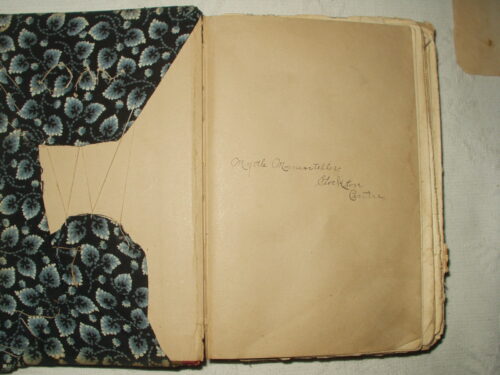
Imagine the oldest child receiving the book. His or her name might be written inside. The book is covered. It goes to school. Years pass. The child moves on to the next level. The book is still perfectly useful. So it is given to the next child. Perhaps that child writes a name inside too. The same little cloth cover continues to protect it. Eventually, the children are grown and the book is no longer needed. But the book survives. And today, we can still see the marks left by the hands and materials of that earlier household. There is something rather lovely about that .We tend to think of history as being preserved in important documents, beautiful furniture, fine clothing and objects belonging to famous people.
But history also survives in **schoolbooks wrapped in scraps of calico. It survives in a child’s pencil marks. In worn corners. In names written on flyleaves .And sometimes, as with these books, in the darkened impression of a thread that once held a homemade cloth cover securely around a book that someone very much wanted to protect.
A little cloth coat for a schoolbook. Made at home. Used for years. Passed from one child to another. And somehow, all these years later, still carrying the evidence of the hands that cared enough to make it.