There is something wonderfully romantic about a lady’s boudoir of the 1920s.
**Silk Before Breakfast**
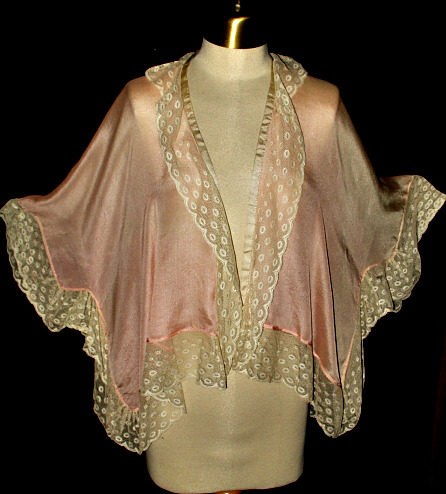
The morning might begin with a silk or satin bed jacket, perhaps delicately trimmed with lace or embroidery.
These were not necessarily grand garments. Some were wonderfully simple, made from lovely fabrics and finished with just enough ornament to make them special. A little lace along an edge, a ribbon tie, perhaps a scattering of embroidery—and suddenly an ordinary morning garment became something quite charming.
The soft pink bed jacket pictured here is just the sort of piece that makes one imagine the woman who once wore it.
Lightweight and delicate, with its lace-edged front and sleeves, it has that unmistakable feeling of a garment meant for private moments rather than public appearances.
And isn’t that part of its charm?
It was made to be seen by very few.
**The Language of Ribbon**
If there was one thing that belonged naturally in the boudoir, it was ribbon.
Ribbon appeared everywhere.
It tied a dressing gown, decorated a corset cover, finished a lingerie drawer, adorned a hat, held flowers, trimmed a slipper—or simply sat prettily in a box waiting for the next bit of sewing.
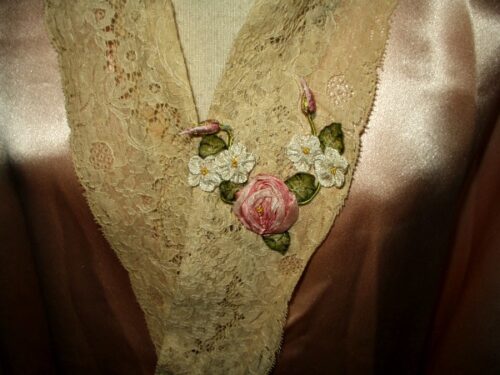
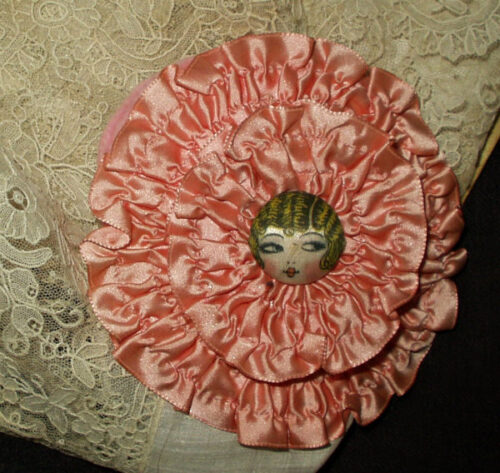
Pink satin ribbon was especially irresistible. Add a little gathered trim, a bit of old lace and perhaps a tiny silk flower, and you have the beginnings of something wonderfully feminine.
Looking at old ribbons today, I sometimes wonder how many hours were spent choosing just the right shade.
Not simply *pink*, but the particular pink.
Not simply *lace*, but the lace that would make the ribbon look prettier.
That attention to small details is one of the things I find so enchanting about these old textiles.
The boudoir wasn’t necessarily an extravagant room. In fact, some of the most charming examples were filled with quite ordinary household things—only they were softened by the presence of textiles.
A padded hanger.
A little silk-covered cushion.
A box holding ribbons and flowers.
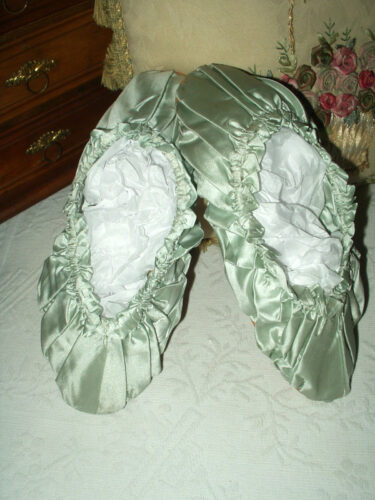
A pair of slippers.
A dressing table scattered with brushes, perfume bottles and hair ornaments.
Perhaps a handmade sachet tucked among the lingerie.
And everywhere there were fabrics.
Silk had a particular magic. Satin caught the light. Lace softened an edge. Ribbon added color. Pleating created texture. Tiny flowers brought a touch of the garden indoors.
Even something as simple as a hanger could become decorative when covered in gathered silk and finished with a bow.
**The Little Things We Almost Forget**
Perhaps that is what I love most about collecting old textiles.
The grand pieces are wonderful, of course. But it is often the little things that tell us the most about everyday life.
A length of faded ribbon.
A silk flower that has lost a little of its color.
An old lace edge.
A padded hanger carefully covered in fabric.
A pair of decorative shoe forms.
A delicate bed jacket waiting patiently after nearly a century.
These objects were never intended to become antiques.
They were simply part of someone’s life.
Someone dressed in the morning.
Someone carefully folded her clothing.
Someone saved a beautiful piece of ribbon because *surely it could be used for something*.
Someone tucked away a favorite garment.
And then, somehow, those small remnants of a woman’s private world survived.
**A Glimpse Behind the Bedroom Door**
The 1920s brought enormous changes in women’s lives and fashions. Clothing was becoming less restrictive, silhouettes were changing, and the modern woman was beginning to emerge.
Yet there was still room for softness.
There was still room for silk.
There was still room for a little extravagance in the privacy of one’s own bedroom.
Perhaps that is why these pieces continue to speak to us.
They aren’t merely old clothing or bits of trimming.
They are **intimate pieces of everyday history**.
A glimpse into a time when even the quietest corner of a woman’s home could be filled with satin, lace, ribbon and flowers.
And if we are very lucky, a few of those beautiful little things still find their way into our hands nearly a hundred years later.
**Madame’s boudoir may be long gone, but her ribbons, silks and satins remain—and they still have stories to tell.**