There was a time when Sunday dinner called for the good tablecloth.
Not necessarily because the meal itself was elaborate, and not because the table needed to impress anyone. Rather, Sunday had its own quiet importance. It was a day to slow down a little, to gather the family around the table, and to bring out the things that were meant to be used with care.
And among those things were the fine linens.
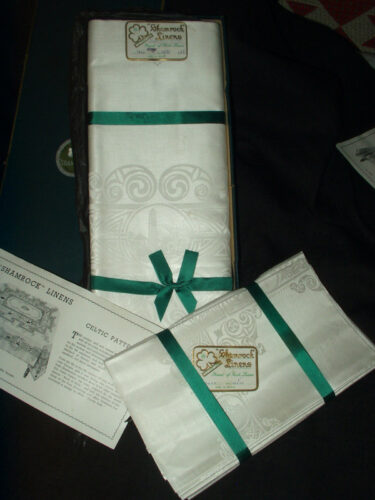
During the early years of the 20th century, roughly from the 1900s through the 1920s, a beautifully set table often began with a white cloth. Linen was especially prized, although fine cottons and other carefully made fabrics found their place in the household as well.
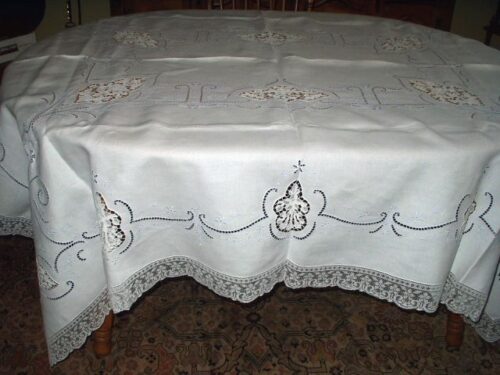
The cloth might be plain and beautifully woven, patterned with damask, edged in lace, or decorated with embroidery, drawnwork, or delicate openwork. Some carried initials worked into a corner. Others displayed elaborate borders that could take countless hours to complete.
Whatever its decoration, the white tablecloth had a way of changing the room.
A familiar kitchen or dining room suddenly looked different beneath a freshly laundered cloth. The surface was clean and bright. The silver seemed to sparkle a little more. Glassware caught the light. Even a simple Sunday meal became something worth sitting down for.
The Work Behind The Beauty.
Today, it is easy to look at an old embroidered or drawnwork cloth and see only the finished piece.
But someone once sat down and made it.
Perhaps the fabric had first been purchased as yardage. Perhaps it was a piece intended to become part of a young woman’s household linens. Perhaps the design was selected from a pattern, transferred to the cloth, and then worked stitch by stitch.
There were hems to make, threads to draw, designs to embroider, and hours to spend.
Some linens were professionally woven or decorated, while others were the result of considerable handwork done at home. In either case, the finished cloth represented something more than decoration. It represented the belief that ordinary household objects could—and perhaps should—be beautiful.
That is one of the things I find so appealing about these early linens.
They were made for use.
They were not created simply to be admired in a cabinet. They were spread across tables, washed, ironed, folded, put away, and brought out again.
And somehow, that makes their survival all the more remarkable.
## The White Tablecloth
There is something almost timeless about a white table.
White linen has a particular ability to make a table feel both simple and elegant. It doesn’t compete with the dishes, flowers, or food. Instead, it provides a quiet foundation for everything placed upon it.
Perhaps that is why white and ivory linens have remained so desirable to collectors.
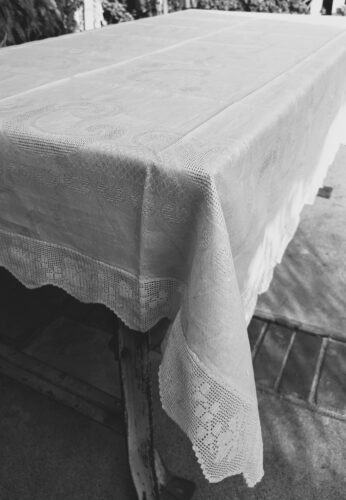
A fine damask cloth may reveal its design only when the light moves across the woven surface. An embroidered cloth may appear almost plain from a distance, only to reveal flowers, vines, initials, or intricate borders when seen up close.
And then there are the linens that show the hand of their maker most clearly—drawnwork, pulled thread, cutwork, needlework, and tiny decorative stitches.
The closer you look, the more there is to discover.
## Saved for Sunday
I often wonder how many of these cloths were once considered too special for everyday use.
Perhaps they were folded carefully and stored in a linen cupboard, waiting for Sunday.
Maybe they came out when relatives visited. Maybe they were used for Christmas dinner, a birthday, or an afternoon gathering. Some may have been part of a young woman’s trousseau, carefully made or purchased in preparation for establishing her own home
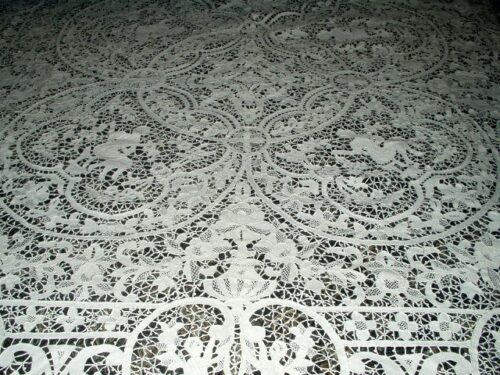
There is something wonderfully familiar about that idea
We still have the impulse to save something beautiful for the right occasion.
But the old table linens remind us that the “right occasion” did not always have to be extraordinary.
Sometimes it was simply Sunday.
## The Care of Fine Linens
Fine linens required care, too.
They were washed, starched when appropriate, and carefully ironed. A large tablecloth could be quite a project in itself. Once pressed, it needed to be folded neatly so it would be ready the next time it was needed.
That care is visible in many surviving pieces.
Some old linens have softened beautifully with age. Others retain the crispness of their original weave. A few show evidence of years of use—tiny repairs, faint stains, or a bit of wear along an edge.
I don’t necessarily see those things as flaws.
They are part of the history of the cloth.
A perfectly preserved linen tells us one story. A well-loved one tells us another.
## Why We Still Love Them
Perhaps it is because these linens represent a slower kind of living.
Or perhaps it is because they combine two things that rarely seem to exist together anymore: **usefulness and beauty**.
An old tablecloth was expected to do a job. It protected the table and provided a clean surface for a meal. Yet someone also took the time to weave a pattern into it, embroider a border, work a monogram, or finish an edge with lace.
There was no need to choose between practical and beautiful.
They could be both.
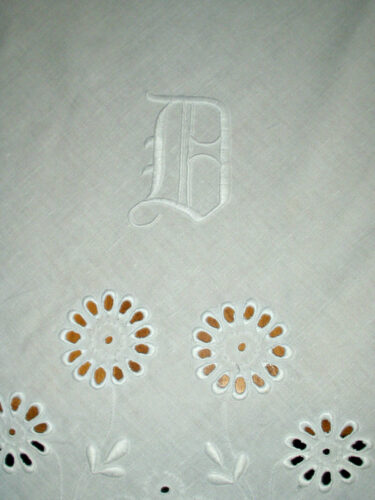
That is what makes early 20th-century table linens so appealing today. We can admire the workmanship, study the fabric, wonder about the woman who made or used it, and still imagine putting it on a table.
Perhaps that is the greatest compliment we can give an old linen.
Not simply that it survived.
But that, more than a hundred years later, we can still imagine using it.
## A Table Worth Setting
I like to think about the moment when the cloth was finally taken from the linen cupboard.
The table was cleared.
The cloth was unfolded and smoothed into place.
The dishes were brought out. Perhaps there were flowers from the garden, polished silver, or simply the family’s everyday plates.
Nothing extravagant was required.
The white cloth did much of the work.
And for a little while, an ordinary meal became something more—a Sunday table, carefully prepared, with the best linens brought out because the people gathered around it mattered.
More than a century later, these cloths still carry that feeling.
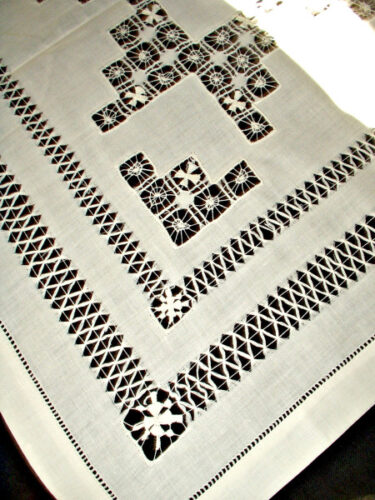
They are beautiful because of their workmanship, certainly. But they are also beautiful because they were part of someone’s life.
And perhaps that is why, when we unfold an old linen today, we pause before putting it on a table.
We are not simply looking at a piece of fabric.
We are looking at a small surviving piece of a household, a tradition, and a time when **setting the Sunday table was itself an act of care.**