There was a time when elegance did not depend on precious metals.
In the years spanning the late 1930s into the early 1940s, materials once considered humble—aluminum among them—were shaped into objects of quiet beauty. Lightweight, practical, and readily available, aluminum became a thoughtful substitute for silver during an era marked by economic restraint and, soon after, wartime necessity.
And yet, what emerged was not merely practical.
It was graceful.
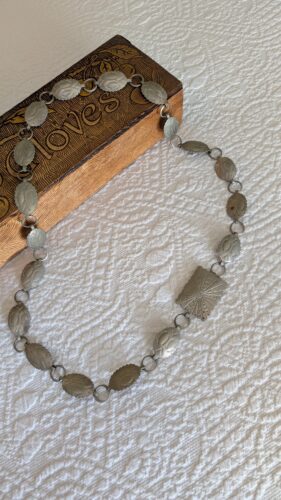
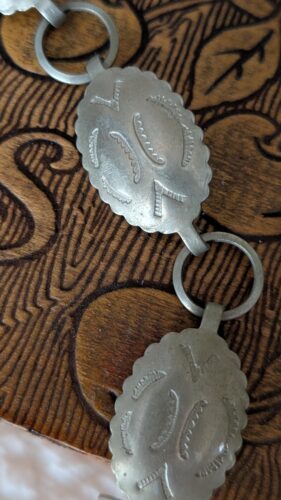
This vintage hammered aluminum belt is a lovely example of that moment. Each link, softly worked by hand, carries a gentle texture—never overly polished, never demanding attention. Instead, it reflects light in a subdued way, as though it understands its role: to complement rather than command.
The design itself tells a story of transition.
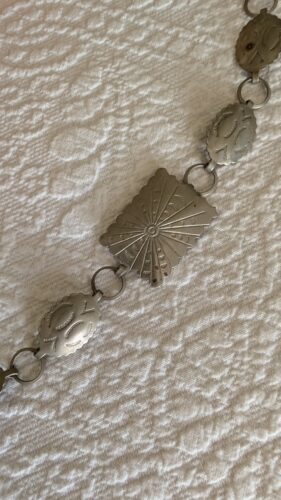
The repeating oval links feel organic, almost softened compared to the sharper geometry of earlier Art Deco pieces. And at the center, the buckle offers a quiet flourish—a radiating motif that hints at the sunbursts and stylized florals of the Deco era, now interpreted with a lighter, more restrained hand.
It is, in many ways, a bridge between two worlds.
Before it, the glamour and symmetry of the 1920s and early 1930s.
After it, the streamlined practicality of wartime and postwar design.
What makes pieces like this so special is not just their age, but their intention. They were made to be worn, to be lived with—light on the body, adaptable, and enduring.
Even today, the belt feels relevant.
Worn with linen, cotton, or a simple dress, it brings with it a sense of history that does not overwhelm. It simply settles in, as it always has, as a finishing touch.
A quiet one.
And perhaps that is its greatest charm.