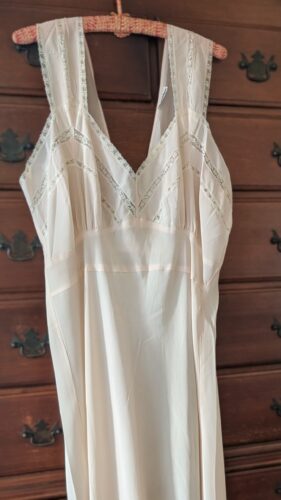
There are times, as a collector, when the object itself must stand in for the archive.
This Alberta Lingerie nightgown is one of those times.
Unlike many better-documented lingerie houses of the mid‑20th century, Alberta Lingerie left behind little in the way of advertisements, catalogs, or recorded company history. What remains — and what matters — is the work itself. The cut, the fabric, the finishing, and the quiet decisions made by skilled hands.
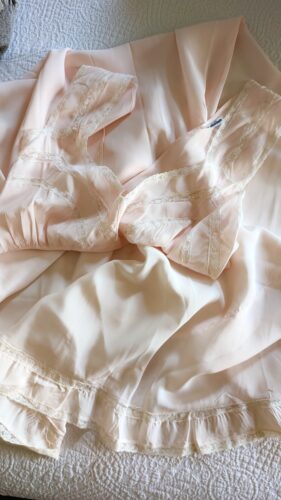
When Records Are Sparse, Construction Speaks
Dating from the late 1940s to very early 1950s, this gown is cut on the bias, a technique requiring both experience and confidence. Bias cutting allows fabric to move with the body, creating a fluid drape that skims rather than clings. It is a choice associated with quality rather than economy, and one most often reserved for garments meant to feel luxurious against the skin.
The rayon fabric, rendered in a soft blush pink, carries a gentle sheen — not flashy, but luminous. It is the sort of fabric selected not simply for beauty, but for how it behaves when worn: cool, fluid, and responsive to movement.
Design That Reveals Intention
Both the front and back of the gown are shaped into deep V necklines, balanced by wide shoulder straps that are delicately trimmed with lace. These straps provide structure while maintaining visual softness — a thoughtful compromise between elegance and wearability.
The empire waistline sits just beneath the bust, where the fabric is softly gathered and enhanced by lace inset panels. These lace insets are not decorative afterthoughts; they are placed to shape and emphasize the bust line, revealing a careful understanding of fit and proportion.
Below the waist, the skirt falls freely into a swing silhouette, moving easily with the wearer. The hemline is finished with a narrow ruffle edged in lace — restrained, feminine, and entirely appropriate to the period. Nothing here is excessive. Every detail serves the whole.
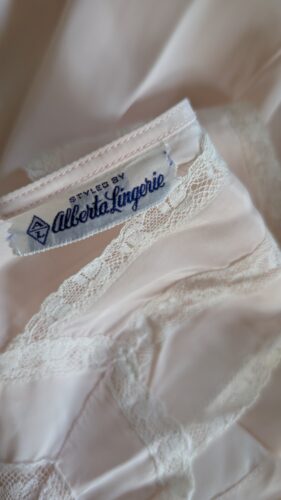
The Label as a Quiet Signature
Inside the gown, the Alberta Lingerie label remains intact. In cases like this, a surviving label is not simply a name — it is a signature. It tells us that the maker stood behind the garment enough to mark it, even if the wider world never recorded their story.
What we can say with confidence is that Alberta Lingerie understood their market: women who valued refinement, comfort, and subtle glamour. This was not lingerie meant to be disposable. It was meant to be kept.
Condition as Evidence of Care
Perhaps most telling is the condition of the gown today. It appears unworn or very lightly worn, with no tears or repairs, and only a single faint oxidation spot on the lower skirt — small, honest evidence of age rather than use.
Such preservation suggests intention. This was likely a special garment, set aside rather than worn nightly. Possibly part of a trousseau, possibly reserved for occasions that never quite arrived. We may never know — but the care it received is unmistakable.