In 1921, when this McCall pattern was printed, sewing for both family and dolls was simply part of everyday life. Mothers, grandmothers, and older sisters often made little dresses and undergarments for a child’s favorite doll from scraps left over from household sewing. The same fabrics used for children’s clothing—cotton lawns, ginghams, dimities, and soft muslins—might find their way into a tiny dress meant for a cherished toy.

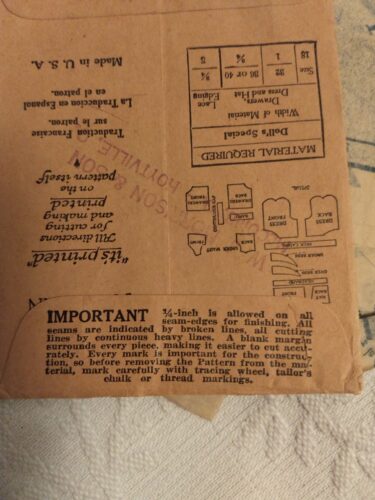
This particular pattern was created for an 18-inch doll and includes a sweet ensemble: a baby-style dress with a ruffled hem, matching underwear, and a fashionable little cloche hat. Even dolls followed the fashions of the day, and by the early 1920s the cloche hat had become the most modern accessory a lady—or her doll—could wear.
What makes this pattern especially charming is that it remains unused and complete, still accompanied by its original Printo Gravure instruction sheet. These early instruction sheets were part of a transitional printing method used by McCall during the early twentieth century, before the modern folded instruction sheets we recognize today became standard.

Even the envelope carries its own small story. Stamped neatly on the front are the names of the merchants who once sold the pattern: W. J. Morrison & Son of McComb, Ohio, and Holtville, Ohio. One can easily imagine the small-town dry goods store where patterns hung in wooden drawers behind the counter. A young girl might have come in with her mother, carefully choosing a pattern so she could sew something special for her doll.
It is a gentle reminder of how creativity and thrift went hand in hand in earlier generations. A child learned sewing not only as a practical skill but as a small act of care—making something lovely with her own hands.
Patterns like this are more than sewing instructions. They are quiet pieces of social history. They tell us how people lived, how they learned skills, and how even playtime carried a sense of craft and imagination.
And perhaps the nicest thought of all is that this little pattern, printed over a century ago, could still be used today. Somewhere, a doll might once again receive a new old-fashioned wardrobe—stitched together just as it would have been in 1921.