And it raises a simple question:
**Why does Art Deco still feel so modern?**
The answer, I think, lies in its clarity.
Art Deco design stepped away from the softness and ornament of the Victorian world and embraced something new—something structured, deliberate, and confident. Lines became cleaner. Shapes became bolder. Circles, arcs, chevrons, and symmetry took center stage.
It was a style born of movement.
The 1920s were a time of change—cities growing upward, technology advancing, music evolving. There was energy in the air, and designers responded with forms that reflected that momentum. Everything from architecture to textiles began to echo this new rhythm.
And unlike many decorative styles, Art Deco didn’t rely on nostalgia.
It looked forward.
That may be why it continues to resonate so strongly today. When we see those geometric patterns—whether in a piece of beadwork, a building façade, or a modern interior—they don’t feel tied to the past. They feel intentional. Balanced. Surprisingly current.
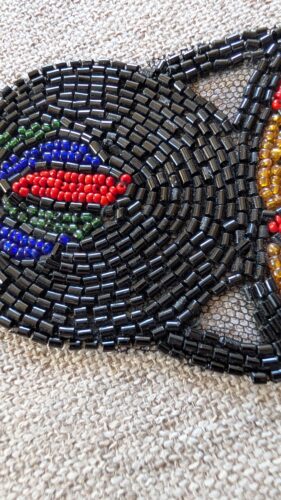
Even in something as delicate as hand-beaded appliqué, the structure is unmistakable. Each segment carefully placed, each color chosen with purpose. There is no excess—only design.
And that is what gives Art Deco its staying power.
It translates.
From the shimmer of glass beads on black tulle…
To the steel lines of a city skyline…
To the quiet geometry of a well-designed room…
The language remains the same.
Perhaps that is why we are still drawn to these pieces—not simply because they are old, but because they still *belong*.
They fit effortlessly into the present while carrying the spirit of a remarkable past.
A rare balance.
And a reminder that truly good design never disappears.
It simply waits to be seen again.