There is something especially tender about a holiday remembered not in fireworks, but in thread and cotton.
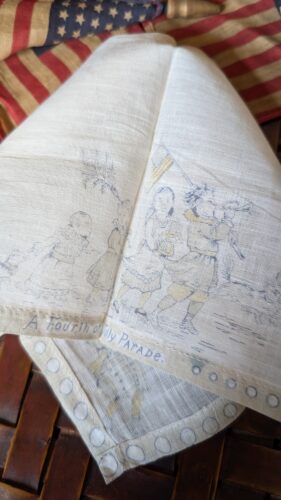
This small handkerchief, softly worn by time, tells its story in a whisper rather than a shout. Around its border, a parade unfolds—children stepping forward with quiet pride, a little drummer boy marking the rhythm of the day, and a dog and cat trailing along as though they, too, understood the importance of the occasion.
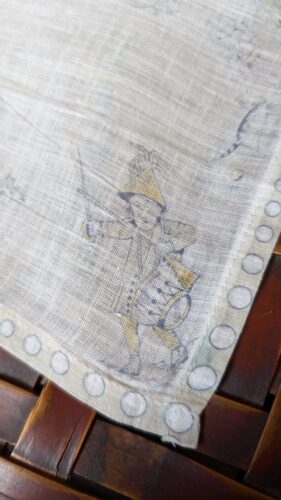
The title, *“A Fourth of July Parade,”* still lingers along the edge, a gentle declaration of celebration. Yet it is not bold or bright as it once was. Years of careful washing have softened the colors into pale blues and warm, faded golds. What remains feels less like decoration and more like memory.
One can almost imagine the child who once carried it—tucked into a pocket or held in a small hand during a real parade, beneath summer skies. Perhaps it was waved, or used, or simply kept close. And afterward, washed and folded, again and again, until the scenes upon it grew quieter with each passing year.
And yet, nothing has truly been lost.
Instead, the piece has taken on a different kind of beauty—the kind that belongs to objects that have been *lived with*. Its softness, its fading, its gentle presence all speak to a time when even the smallest things were made with care and meaning.
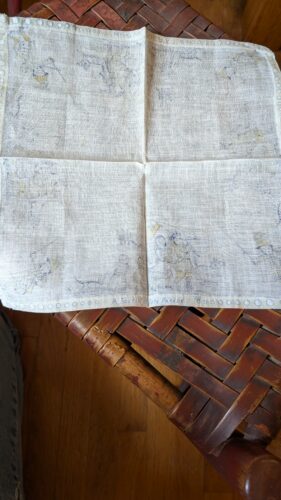
Now, it rests as a keepsake of that earlier world. Not loud, not perfect—but enduring.
A Fourth of July, remembered not in noise, but in cloth.