There are certain pieces that do not call out loudly, yet linger with a soft and persistent voice. This delicate photo card of a child dressed in the style so closely associated with Kate Greenaway is just such a treasure—quiet, poetic, and full of unspoken story.

At first glance, it is the simplicity that draws one in. A child, carefully posed, clothed in that unmistakable mode—high-waisted frock, gentle lines, and an air of innocence that feels almost theatrical in its sweetness. Yet this is no costume in the modern sense. Rather, it reflects a period moment when art and daily life intertwined, and when the influence of illustration shaped how childhood itself was imagined and presented.
The “Greenaway look,” as it came to be known, emerged in the late 19th century, inspired by idyllic visions of childhood set in an earlier, almost storybook England. Mothers embraced these styles for their children, favoring soft fabrics, delicate construction, and a modest elegance that spoke of purity and refinement. Clothing became not just practical, but expressive—an outward reflection of innocence carefully preserved.
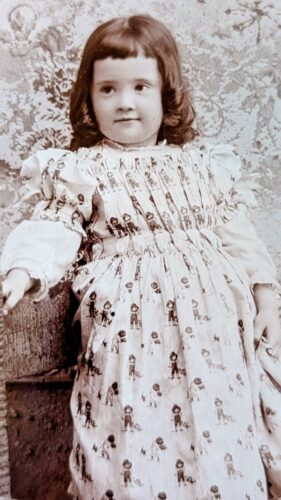
In this photo card, one can almost feel that intention. The child stands as both subject and symbol: a real young life, momentarily held still, and at the same time a living embodiment of an artistic ideal. There is something deeply touching in that balance. The image does not feel stiff, but rather gently composed, as though it were meant to be cherished quietly over time.
These cards were often exchanged, tucked into albums, or sent as tokens of affection. They traveled through hands and homes, gathering meaning as they went. Today, when one surfaces, it carries not only its original beauty but also the invisible weight of those years—who admired it, who saved it, and why it was kept.
What makes this particular piece so lovely is its ability to still evoke that sense of tenderness. In a world that moves quickly, it invites us to pause. To notice the details. The fall of fabric, the posture of the child, the careful staging that speaks of pride, care, and a desire to preserve a fleeting moment.
It is, in its own small way, a reminder of how childhood was once idealized—not as something hurried through, but as something to be lingered in, observed, and gently framed.

And perhaps that is why such pieces continue to find their way into our hands. Not simply as collectibles, but as quiet companions—holding within them a softness that still resonates, more than a century later.
Added Notation:

Captured in **1891 by the J. Strause studio of St. Louis**, this cabinet card preserves a moment of quiet childhood charm, made all the more special by the little girl’s delightful **Kate Greenaway–inspired dress**.