There are moments in collecting when an object, long familiar, suddenly asks to be seen again—not with fresh eyes, but with kinder ones.
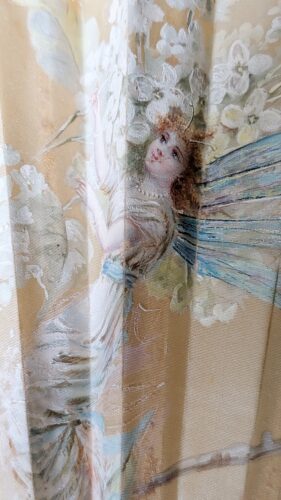
This Tiffany & Co. fan has been with me for many years. It rests in its original satin presentation box, the inside of the lid quietly marked Tiffany & Co., a detail that still gives me pause. Time has not been gentle with either the box or the fan it once protected so elegantly. The satin lining has begun to shred; the painted silk leaf bears splits along its folds. And yet, when I lifted it again after years, I did not see ruin. I saw survival.
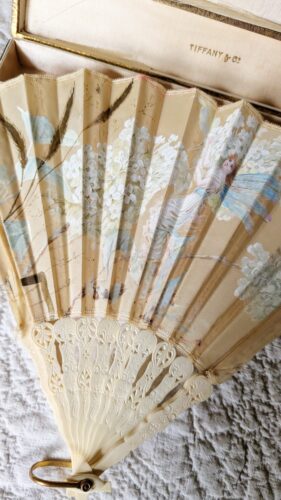
I did not open the fan fully.
The ends of the silk are fragile now, and I felt instinctively that to press further—to satisfy curiosity or claim completeness—would be a small betrayal. Some objects ask us to stop. This fan was one of them.
At first glance, the decoration appears floral, with soft blossoms drifting across a warm, golden ground. But at the center—only partially revealed—there emerges not a bird, as one might assume at a distance, but a winged lady. She is delicately rendered, almost ethereal, her presence more suggested than declared. She belongs to that turn-of-the-century world Tiffany embraced so beautifully: allegory, nature, and idealized femininity intertwined.
Winged figures of this sort were never meant to shout. They were meant to be discovered slowly, perhaps incompletely. In that sense, it feels fitting that she now reveals herself only in part, as though time itself has drawn a veil.
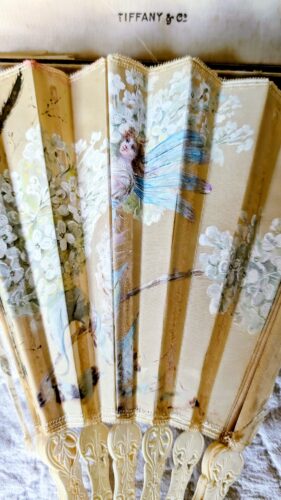
The fan likely dates to the late Victorian or early Edwardian period, when Tiffany & Co. offered luxury accessories sourced from fine makers, chosen for their beauty and modernity. Painted silk fans were fashionable yet fragile even when new. Paint stiffened the silk; folds weakened; life happened. These were not objects designed for permanence. They were meant for evenings, for movement, for hands and air.
That this one remains at all—still paired with its original box—is remarkable.
Condition, in such cases, tells a story rather than diminishing one. The splits in the silk, the wear to the satin lining, speak not of neglect but of age and material truth. They remind us that beauty has always been vulnerable, and that luxury objects were once part of everyday life, not museum cases.
There is a temptation, when faced with something rare, to want it whole again. To repair, restore, or fully reveal. But I have come to believe that stewardship sometimes means restraint. Knowing when not to open the fan any further. Knowing when to let mystery remain.

Today, this fan rests quietly once more, supported and protected, its winged lady still half-hidden. I no longer feel at a loss when I look at it. Instead, I feel gratitude—for its survival, for its fragility, and for the reminder that some things are most beautiful when we allow them to be exactly as time has left them.
Not everything needs to be unfurled.
Sometimes, it is enough to know what waits inside.