There is something quietly arresting about a piece of linen that looks back at you.
Not in a bold or theatrical way, but softly—through the suggestion of a face worked into thread, emerging from the calm surface of white fabric. Such is the case with a pair of antique Italian pillow shams I recently brought out from long keeping.
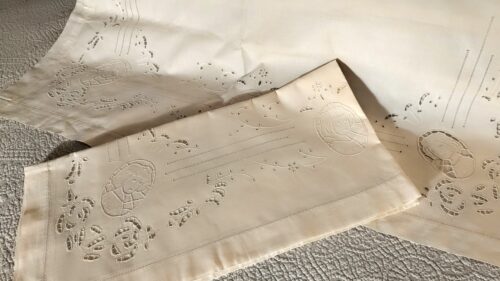
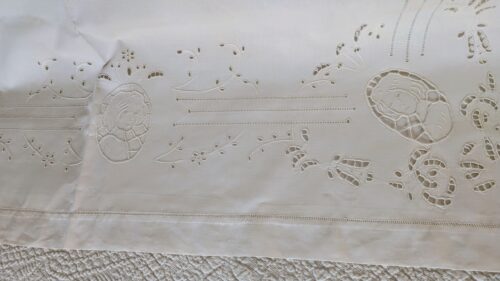
At first glance, they are refined examples of drawnwork and embroidery, the kind one might expect from the late Victorian or Edwardian period when household linens were still a canvas for patient handwork. The linen is fine, the scale generous, and the design thoughtfully arranged along the lower portion—meant to be seen when placed upon a bed, the upper expanse left plain in quiet contrast.
But it is the faces that hold your attention.
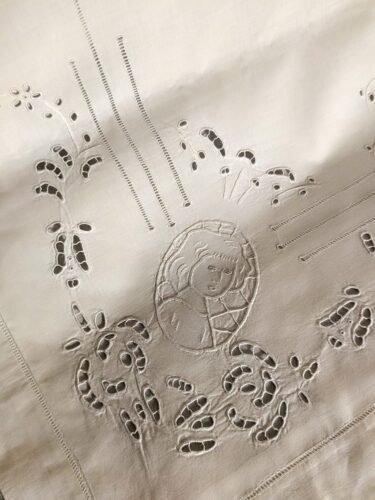
Three on each sham—one centered, two at the corners—framed in delicate oval medallions. They are serene, almost classical in feeling, surrounded by stylized foliage that moves gently across the surface. There is balance here, and intention. One senses the hand of a maker who understood not only technique, but composition.
And then, a small mystery.
On one sham, the fabric within one of the faces has been cut away, while all the others remain intact. It is not damage in the usual sense—it feels deliberate, or at the very least, considered. Was it an experiment? A moment of reinterpretation? Or perhaps a later hand, altering what was once uniform?
These are the quiet questions that antique textiles sometimes carry with them. They remind us that these objects were not static—they lived, they were handled, altered, appreciated in ways we can only partly trace.
Italian linens of this sort speak to a tradition where beauty was not reserved for display alone, but woven into the everyday. Even a pillow sham—something so ordinary in purpose—could become a work of art through skill and time.
And so they remain with us, these pieces.
Not just as decorative objects, but as small continuations of lives once lived—stitched, quite literally, into cloth.