There is something especially moving about the dolls that remain.
Not the pristine ones, carefully preserved in boxes and untouched by time—but the survivors. The ones that lived a life, that were held, dressed, carried, and loved so completely that only part of them endured.
These two small dolls are just such survivors.
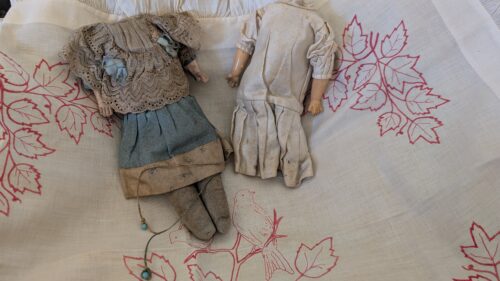
Dating to the early years of the 20th century, they come to us without their heads, and yet they have lost none of their presence. In fact, there is something in their quiet incompleteness that feels even more powerful—more human, somehow. They ask us not to see what is missing, but to imagine what once was.
### **A Voice from the Nursery**
The larger doll, measuring about 11 inches, still holds one of the most tender surprises.
When her small pull-string is gently drawn—finished with two tiny blue glass beads—she releases a soft cry. It is a fragile, mechanical sound, but unmistakably expressive. A voice that has endured for over a century.
One cannot help but pause at that moment.
Who last heard her cry when she was new?
A child in a nursery? A careful mother?
Was she a comfort, a companion, a treasured possession?
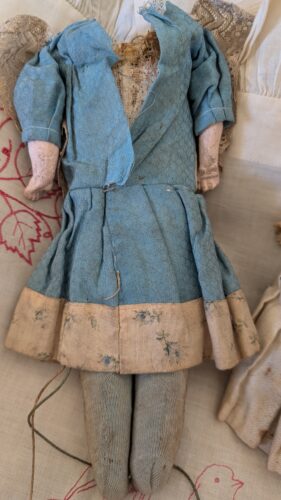
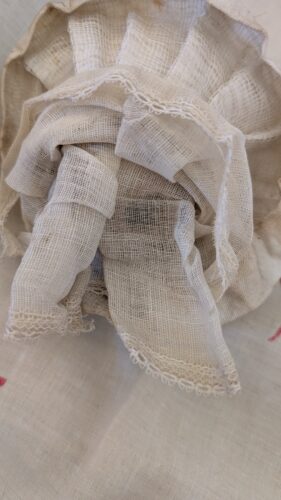
Her cloth body remains firmly stuffed, with that slightly “crunchy” feel so familiar to collectors—likely filled with excelsior or straw, just as many dolls of the late Victorian and Edwardian periods were. Her bisque hands, still present and delicately formed, offer a glimpse of the refinement these dolls once possessed.
And then there is her dress.
A soft blue cotton, gently faded with time, adorned with a lace-worked yoke and a printed border near the hem. The style reflects the romantic influence of the Gibson-era—an aesthetic that favored softness, femininity, and quiet grace. Even now, the dress holds its charm, its folds telling of years gone by.
She still wears her undergarments. Her wool stockings remain in place.
She is, in every way, a small fragment of a world that once was.
### **The Smaller Companion**
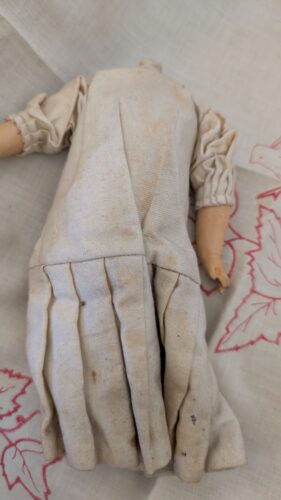
Beside her is a second doll— the body just 5 inches in height.
A quieter presence, perhaps once tucked into a pocket or carried alongside her larger companion. She too retains her bisque hands and her simple white dress, now softened with age and use.
Though more modest, she is no less important.
Together, the two form a pair that feels almost inseparable now—bound not only by time, but by survival.
### **What Remains Matters**
It is easy to focus on what is missing.
But in the world of antique dolls—and indeed, in all objects that have lived long lives—it is what remains that tells the story.
The materials.
The construction.
The clothing.
The evidence of care, and use, and years.
These dolls were not made to be perfect forever. They were made to be loved.
And loved they were.
Today, they offer themselves in a different way—not as playthings, but as witnesses. To early childhood, to craftsmanship, to a time when even the simplest toy was made with intention and care.
For the collector, they present many possibilities. Restoration, if one chooses. Display, certainly. Or simply preservation—as they are, honest and unchanged.
But beyond all of that, they offer something quieter.
A connection.
To a nursery long gone.
To small hands that once held them close.
To the enduring charm of objects that have, against all odds, remained.