There is something about a bundle of unused trim that feels almost like a pause in time.
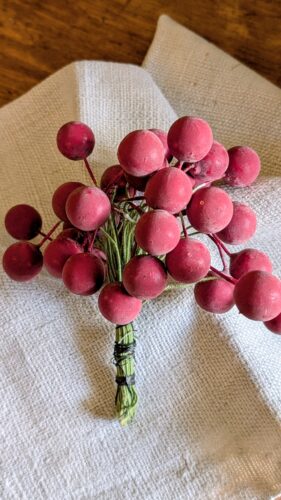
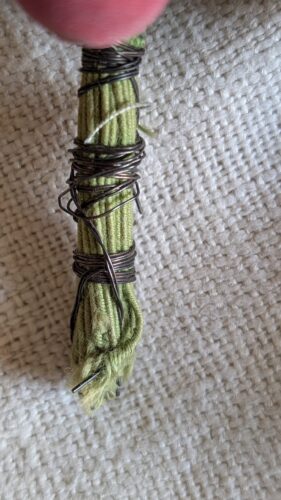
These small plum-red grapes, still gathered tightly together, their stems bound with simple wire, seem never to have fulfilled their intended purpose. They were made to adorn—perhaps the brim of a felt hat, or nestled among velvet leaves on an autumn piece—but instead, they waited. Quietly. Patiently.
I like to imagine the shop they once belonged to.
Not grand, but well-kept. A narrow storefront along a street in Buffalo, with tall windows that softened the daylight just enough to flatter silks and ribbons. Inside, wooden drawers lined the walls, each carefully labeled: *berries*, *flowers*, *veiling*, *feathers*. The air carried that particular scent of cloth, starch, and a trace of dust that gathers only where hands have worked faithfully for years.
A milliner stood behind the counter—perhaps she had been there since the 1920s, her skill carried forward through changing fashions. She would have known exactly when to reach for a cluster like this. Not for every hat. No, something like these grapes required restraint and intention. They belonged to a certain kind of piece—seasonal, perhaps autumnal, with just a hint of abundance.
By the 1940s, times had changed. Materials were sometimes scarce, styles more practical, yet adornment never quite disappeared. Even in simplicity, there was still a desire for beauty—for a small flourish that made something personal.
And so these grapes remained.
Still bundled. Still waiting in their drawer. Passed over, perhaps, for a more immediate need. Or simply kept in reserve for the “right hat” that never quite came.
Years later, when the shop finally closed—its contents carefully gathered and dispersed—this small cluster traveled on. From a workroom drawer to a collector’s hand, and now, here again, offered forward.
There is a quiet poetry in that.
Because while they were never used in their own time, they have not lost their purpose. They have simply been waiting for a different one.
Perhaps to be worn. Perhaps to be displayed. Or perhaps simply to be held for a moment, appreciated for what they are: a small, tangible remnant of a craft, a shop, and a life lived in careful making.
And in that way, they have already done their work.
—
*Notes for the collector:*
Vintage millinery fruit such as these grape clusters was commonly produced in the 1930s through 1950s, often crafted from early plastics or composition materials and mounted on cloth-wrapped wire stems. Full, unused bundles—like this example—are increasingly uncommon, offering a rare glimpse into the working stock of mid-century millinery shops.