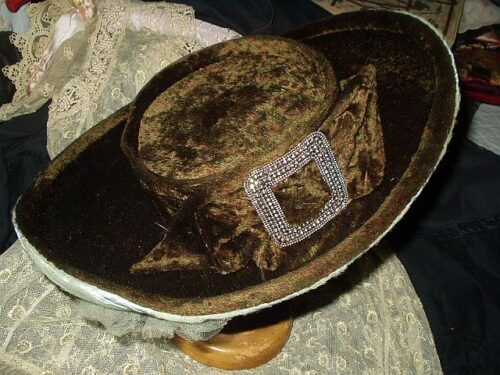
This hat belongs to the latter.
It rests not merely as an accessory, but as a quiet proclamation of prosperity, taste, and the unmistakable confidence of a woman who was seen—truly seen—when she entered a room. The deep, lustrous brown velvet, rich as polished mahogany, absorbs the light in that way only fine, dense pile can do—suggesting quality before one even dares to touch it. And then, that buckle… a glint of brilliance, catching candlelight or early electric glow, whispering just enough sparkle to announce refinement without excess.
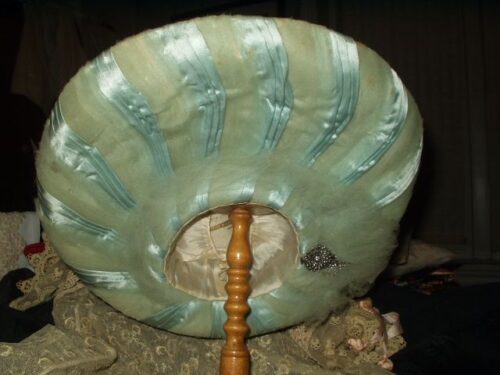
But it is the interior that tells the truest story.
That soft, luminous blue silk lining—almost robin’s egg in tone—speaks of careful craftsmanship and expense. Silk was not chosen lightly. It was chosen because it mattered how a hat felt when lifted, how it cradled the crown, how it revealed itself in private moments before a mirror. The structured interior stitching, radiating like gentle ribs, suggests a professional milliner’s hand—someone trained, practiced, and proud of their work.
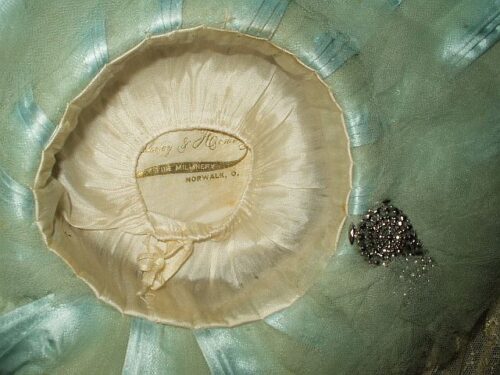
And then… Norwalk, Ohio.
At first glance, it is easy to remember it as modest—quiet streets, practical lives, and farmland stretching outward. And yet, places like Norwalk, rooted in the historic Firelands, carried something more layered beneath the surface. These were communities shaped by New England settlers who brought with them not only industry, but expectation—of education, of culture, of refinement.
Not loud wealth.
But *established* wealth.
The kind that revealed itself not in excess, but in quality. In the cut of a garment. In the choosing of a hat.
My own memories echo this truth so beautifully. The flea markets of Norwalk—where remarkable pieces quietly surfaced time and again—are not accidents of chance. They are the gentle afterglow of a place that once held fine in number. Objects like this hat were purchased, worn, and cherished there because there were women who lived lives that called for such beauty.
And just nearby, Milan, Ohio adds its own quiet chapter to the story.
Small, yes—but deeply connected to the same regional character. A memory of the little museum, and the heartbreaking moment when rain and time forced its treasures into the open, feels almost like a metaphor. History does not always remain safely tucked away. Sometimes it spills out—through circumstance—and finds its way into the hands of those who will recognize it, protect it, and carry it forward.
How fitting that early textiles—fragile, storied, and full of human touch—should have been saved in that moment.
Just as this hat has been.
Because this hat is more than an object of fashion. It is evidence. Evidence that in these “modest” towns, there were lives lived with intention and elegance. Women who understood presentation, who valued craftsmanship, and who stepped out into their world dressed not just appropriately—but beautifully.
The wide brim offers both drama and protection, framing the face in shadow and light—a silhouette that speaks to an era when presence mattered. The velvet suggests cooler seasons, perhaps autumn visits or winter gatherings. And that buckle—brilliant but restrained—marks a woman who understood exactly how much sparkle was enough.
This is not the extravagance of a great city.
This is something quieter, and in many ways, more enduring.
A refinement that lived in places like Norwalk and Milan. In parlors, in church aisles, in social calls, and yes… eventually, in the treasures that would surface decades later on flea market tables, waiting for someone to recognize their worth.
This is not just a hat from Ohio.
It is Ohio—at its most graceful, most grounded, and most quietly elegant—captured in velvet and silk.