There are certain finds that simply stop you in your tracks—and this was one of them.
The moment I saw this striking black handbag with its bold, sculptural handles glowing in rich amber tones, I knew it was something special. It has that unmistakable presence only true mid-century pieces carry—a quiet confidence, a sense of design that is both playful and intentional.
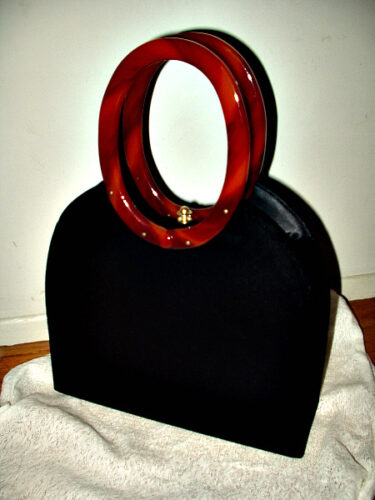
This is a **Bobbie Jerome** handbag, dating to the 1950s, a time when fashion was embracing modernity in the most elegant of ways.
### A Company Rooted in Mid-Century Style
Bobbie Jerome was an American handbag maker active primarily from the 1950s through the 1970s ([The Portal to Texas History][1]). Their designs reflect a fascinating moment in fashion history—when accessories were not just functional, but expressive works of design.
The company operated out of New York City in its early years, placing it right in the heart of American fashion ([bagladyemporium.com][2]). Their handbags were known for being stylish yet accessible, offering women a way to participate in current fashion without the high couture price point ([vintagepursegallery.blogspot.com][3]).
What makes Bobbie Jerome especially interesting is their variety. They worked in everything from velvets and satins to tapestry and patent finishes, often pairing these materials with eye-catching hardware and handles. Many of their evening bags even came as “fitted” sets, complete with mirrors or cosmetic accessories—small luxuries for a well-dressed woman ([vintagepursegallery.blogspot.com][3]).
The Beauty of Form And Materials
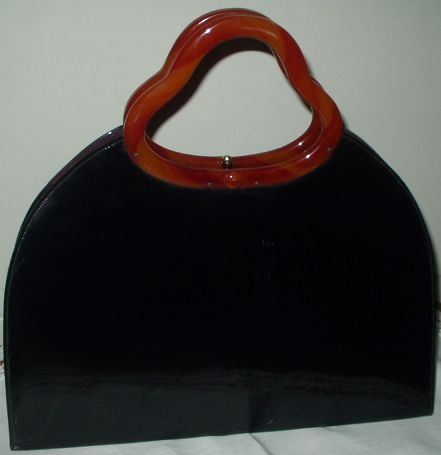
This particular bag is a wonderful example of mid-century ingenuity.
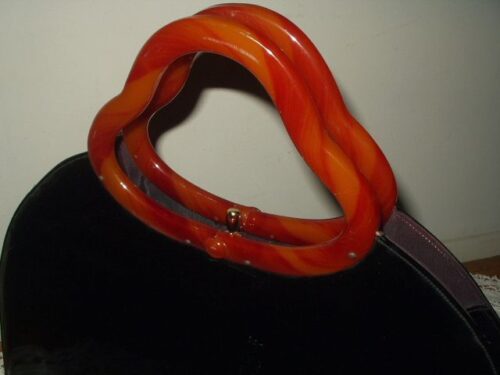
The body is structured and refined, light-absorbing richness so popular in the era. But the true star is the handle—those bold, circular forms in what appears to be **Bakelite or Lucite**, materials that defined mid-century modern design.
Designers of the 1950s were captivated by new plastics. They allowed for shapes that would have been difficult—or impossible—to achieve before. Here, the handle becomes almost architectural, transforming the handbag into something sculptural.
Bags like this were not merely carried—they were *presented*.
### A Reflection of Its Time
The 1950s woman balanced practicality with polish. Handbags were structured, interiors thoughtfully arranged, often including compartments for lipstick, mirrors, and other essentials ([Duty Free Global][4]). Every detail served a purpose, yet nothing sacrificed beauty.
This Bobbie Jerome bag reflects this perfectly. It is both useful and artistic—a companion for an evening out, a church social, or perhaps a special gathering where one wished to be noticed, but with grace.
Why These Pieces Still Matter
Today, pieces like this are cherished not only for their beauty, but for what they represent.
They speak of a time when craftsmanship met emerging modern materials. When even an everyday object like a handbag could carry the spirit of design innovation.
And perhaps most of all—they remind us that style has always been about individuality. Someone chose this bag decades ago because it stood apart. And today, it still does.