There is something quietly personal about the garments we do not often see.
Tucked beneath the outer layers of dress, hidden from view, were the small necessities that made daily life possible—garters, fasteners, ribbons, and ties. They were practical, certainly, but not always plain.
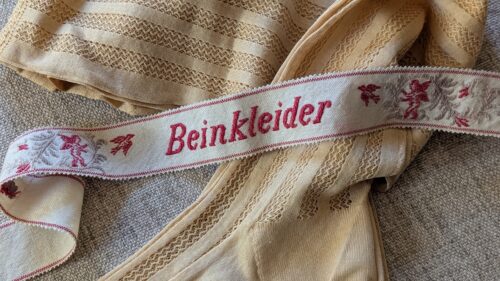
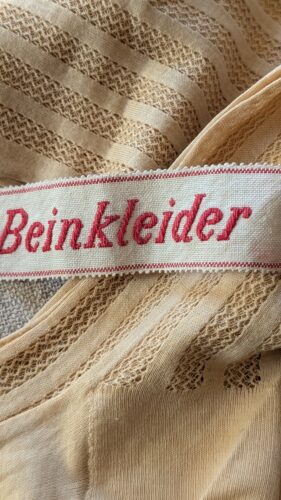
This slender length of linen, embroidered with soft red thread, carries the word *Beinkleider*—a German term for legwear or stockings. It once served a simple purpose: to hold a pair of stockings securely in place. Before elastic became commonplace, such garters were essential, worn above the knee and fastened with small hooks and catches.
And yet, what transforms this piece from mere utility into something memorable is its decoration.
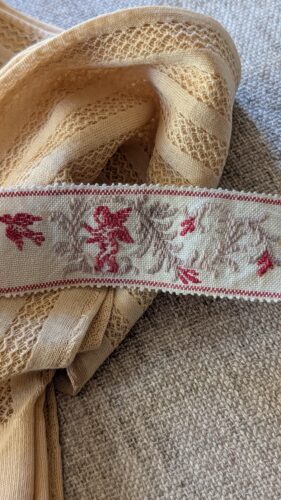
Tiny cherubs, birds, and trailing florals move gently along the ribbon, stitched by hand in a style that feels both intimate and expressive. Cherubs, so often associated with innocence and protection, were not confined to the nursery. They appeared just as readily in the private world of adult dress—on undergarments, ribbons, and personal linens—adding a note of softness to objects meant for everyday use.
It is easy to imagine this garter as part of a carefully assembled wardrobe. A drawer lined with folded linen. Stockings rolled and set aside. A quiet morning ritual of dressing, where even the unseen details were chosen with care.
Time, of course, has altered it. The catch is missing now, and a few threads have loosened. But it remains a survivor—delicate, expressive, and full of quiet history.
Pieces like this remind us that beauty was not reserved only for what was visible. Even the most hidden elements of dress could carry charm, artistry, and a sense of personal identity.
A small ribbon, perhaps—but one that still tells a story.