There are some pieces that whisper… and others that speak clearly across time.
These Art Deco beadwork embellishments—dating from the 1920s into the early 1930s—belong to the latter.
Bold. Confident. Unmistakably modern for their day.
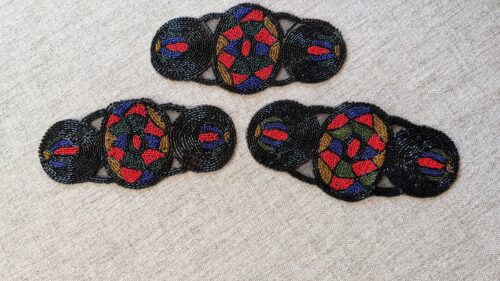
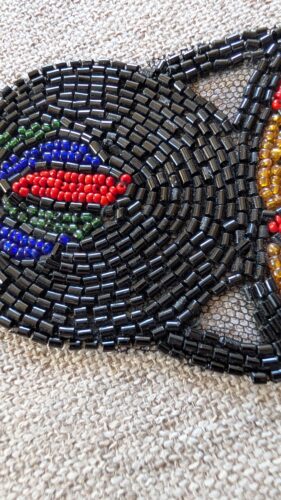
Hand-beaded on fine black tulle net, each appliqué forms a striking circular medallion, built from tiny glass seed beads and slender bugle beads. The palette is rich and deliberate: deep black grounding flashes of red, cobalt blue, green, and warm amber. Even now, nearly a century later, the colors feel alive—almost electric against the netted ground.
This is the language of the **Art Deco era**.
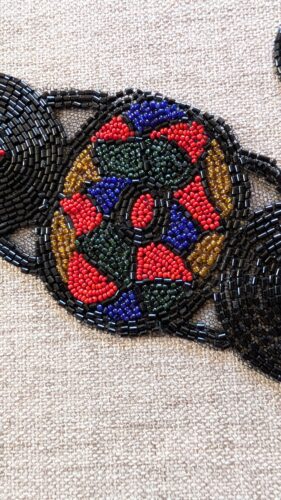
A time when design turned toward geometry, symmetry, and rhythm. Circles, arcs, and repeating segments replaced the soft florals of the Victorian age. The world was changing—faster, louder, more daring—and fashion followed.
One can easily imagine these embellishments catching the low light of an evening room… stitched onto a flapper dress, perhaps worn with movement and music. The beads would have shimmered with every step, every turn, every note of a jazz band drifting through the air.
And yet—these survived.
Unused.
Quietly kept aside for decades, as so many beautiful things were, tucked into drawers or sewing baskets with the intention of “someday.”
That “someday” never came for their original owner—but it has arrived now.
What makes pieces like these so compelling is not only their craftsmanship, but their **completeness of voice**. Even separated from the garment they were meant for, they still tell the story. The design remains whole. The intention is clear.
They are not fragments.
They are *statements*.
Today, they offer themselves again—not just as embellishment, but as inspiration. For collectors, for designers, for those who appreciate the artistry of handwork from a time when even the smallest detail was made to delight the eye.
And perhaps that is why they are so difficult to find now.
Not because they were rare to begin with—but because so few were left untouched.
These are small survivors of a grand moment in design.
And yes… if you listen closely—
They are still speaking.