Description
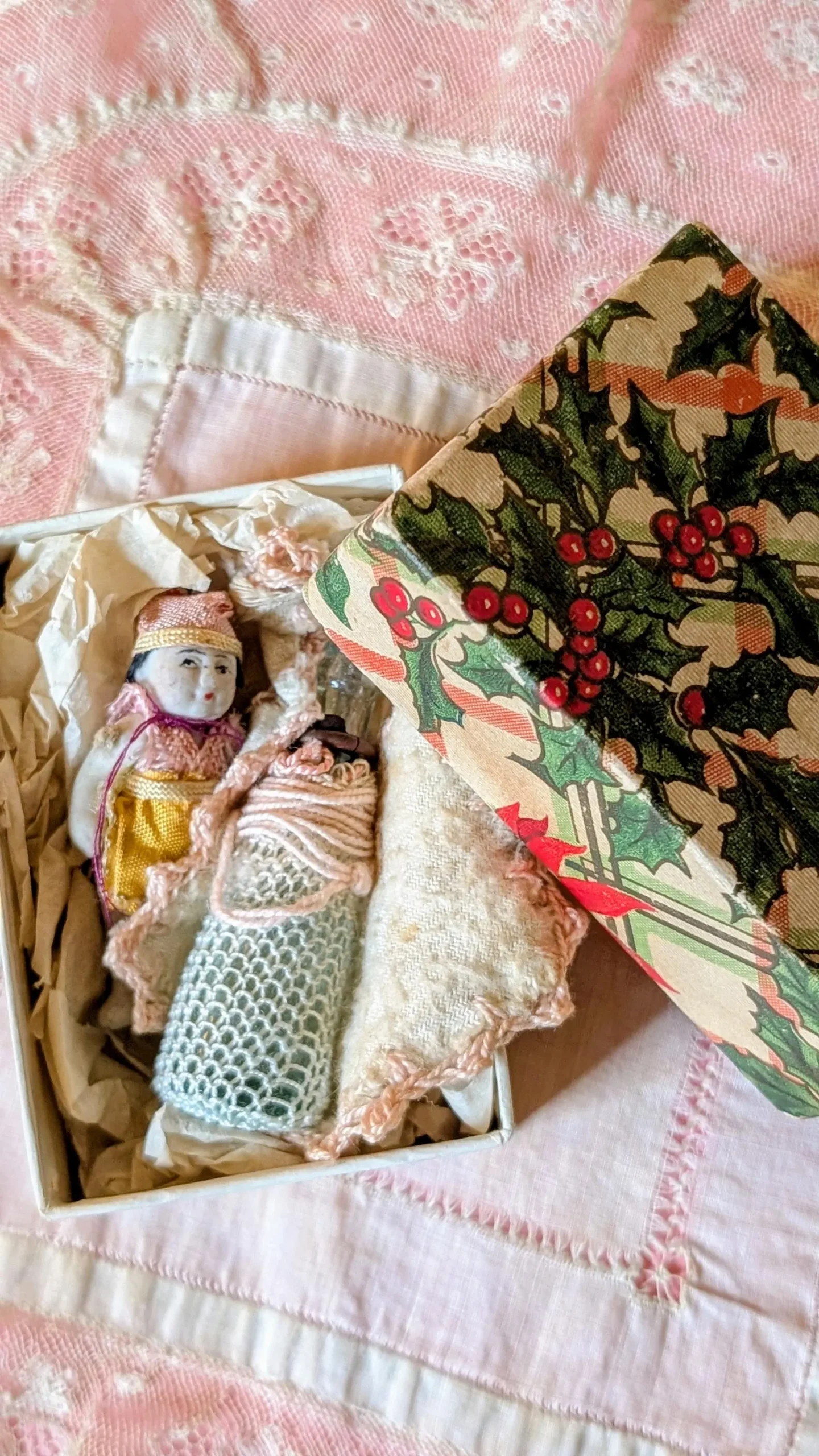
A tender little keepsake from a child’s past, this charming 1920s–1930s miniature doll set has survived together in its original Christmas-papered box—a tiny treasure of early playthings preserved just as they were tucked away nearly a century ago.
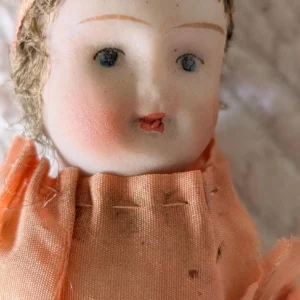
The tiny bisque doll is a 2-inch jointed figure with string-tied movable arms and legs—a style most commonly produced in Japan during the late 1920s and early 1930s, when Japanese factories became major exporters of small novelty dolls to American five-and-dime stores. These little dolls often appeared as stocking stuffers, party favors, or inexpensive children’s toys.
Her original clothing remains intact: a small yellow handmade dress and soft pink thread around the neckline, showing the sweet improvised costume-making typical of children during this period. Condition is very nice, with only gentle age wear.
The Baby Bottle
The miniature glass doll baby bottle measures 2¼ inches tall and approx. ½ inch in diameter at the base. Its form is characteristic of doll bottles from the 1920s–30s, and it wears a charming hand-knitted sleeve in pale blue with pink trim. As is common with bottles of this age, the original thin natural-rubber nipple has not survived.
The Wool Doll Bib
The soft cream wool bib, measuring 2¼ inches wide and 3½ inches long, is edged in delicate pink embroidery. This piece reflects the long tradition of children learning handwork and sewing small garments for their dolls. Though sized for a larger doll than the tiny bisque baby, it adds a wonderfully personal, homemade touch.
The Box
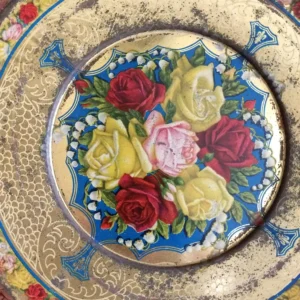
The grouping rests in its old white box, the lid wrapped in cheerful holly-and-berry Christmas paper—a print style widely used during the late 1920s to 1930s. A vintage Christmas seal remains on the bottom, further supporting the dating and lending a nostalgic holiday charm.
A Captivating Early 20th-Century Ensemble
Sets preserved like this—still grouped exactly as they were stored decades ago—are especially evocative. They capture the gentle poetry of early childhood: tiny objects lovingly handled, dressed, and saved. A lovely display for collectors of miniature dolls, early Japanese bisque, sewing and nursery ephemera, or 1920s–30s Christmas memories.
Collector’s Note
During the 1920s–1930s, Japan became a major source for small bisque novelty dolls exported to the United States. Jointed examples like this one, especially with original handmade clothing and companion accessories, are more desirable and increasingly harder to find as intact sets. The charming mix of store-bought and handmade items is exactly what makes early childhood assemblages so delightful to collectors.